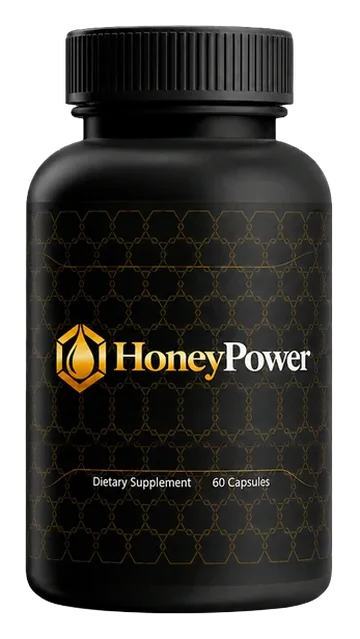
HoneyPower is a newly launched, stimulant-free capsule supplement announced to the U.S. market on September 18, 2026, combining six named botanicals — Tongkat Ali, Epimedium extract, Saw Palmetto, Wild Yam, Sarsaparilla, and Nettle — with the trace mineral Boron. We went looking for the exact formula, the company behind it, and a working place to buy it. Here's exactly what we could confirm, and what's still missing eight days after launch.
These statements have not been evaluated by the FDA. This product is not intended to diagnose, treat, cure, or prevent any disease. It is marketed for general men's vitality and wellness, not as a treatment for any medical condition. Talk to a healthcare professional before starting any new supplement, especially if you take medication or manage an existing health condition.
We have no paid relationship with HoneyPower and are not selling it — see "What we found" below for why. The one product link on this page, further down, is a separate, disclosed Amazon affiliate link.Bottle photo as published on the brand's own storefront. We removed one line of on-label marketing text before using it here — see the note in "What we found," below, for exactly what we did and why.
FormCapsule
Bottle size60 capsules
Serving2 capsules/day with water
StimulantsNone disclosed (caffeine-free)
Manufacturer namedNot disclosed
Working storefrontNot yet, as of this writing
Who's behind it, and where it's sold
A launch this new is unusually easy to fact-check in real time, because the paper trail is only days old. Here's everything we could trace, checked directly rather than taken from any single source.
HoneyPower's introduction was distributed on September 18, 2026 through GlobeNewswire and picked up, word for word, by several regional news sites' syndicated wire sections. That announcement lists a mailing address of PO Box 12730, Ogden, UT 84412 — a post office box, not a facility or office address — and names no manufacturer, parent company, or legal entity behind the "HoneyPower" brand name anywhere we could find. The announcement itself points readers to honeypower.us as the brand's website; when we checked it directly, it loads as an essentially blank page with no product information at all, just the bare domain name.
The functioning storefront we actually found — the one linked from HoneyPower's own checkout flow — is a different domain, honey-power.shop. We checked its raw page source directly, and it is a live website-builder template that was never finished being filled in. Its own on-page text still reads, verbatim: "Add the exact ingredient name, form, amount and compliant description" (repeated for all six botanicals), "Add your actual money-back guarantee, eligibility requirements, refund window and customer support contact", and, in its own footer, "Replace all example claims, prices and policies with verified store information before launch." Every "Order Now" and "See Packages" button on that page, and there are several, routes not to a checkout on honey-power.shop itself but to a third-party affiliate-tracking link at mwebtrackwise.com, carrying a tracking parameter that identifies this specific campaign. In plain terms: eight days after a coordinated press announcement, the brand's named website is blank, its actual storefront is an unfinished template, and its "buy" buttons hand you off to a separate tracking domain before you ever reach a real checkout page.
The ingredient list, exactly as published
The six botanicals plus boron are named consistently across the original press announcement and every outlet that republished it. Amounts are a different story — see the note below the table.
Ingredient
Amount per capsule
Tongkat Ali (Eurycoma longifolia)
Not disclosed
Epimedium extract
Not disclosed
Saw Palmetto
Not disclosed
Wild Yam
Not disclosed
Sarsaparilla
Not disclosed
Nettle
Not disclosed
Boron
Not disclosed
Capsules per bottle
60
The launch announcement itself is upfront about this gap, telling readers to "use the final product label" for the actual formula amounts. That would be a reasonable answer if a final product label were something we could find — but the only public storefront tied to this launch is the unfinished template described above, which doesn't have one either. As of this writing, we could not locate a single public source, vendor or independent, that states a milligram amount for any of these seven ingredients.
What the published research says about these ingredients
None of this research was run on the HoneyPower formula itself — we found no clinical trial of the finished product. These are notes on the individual ingredients, at whatever dose and in whatever population each study actually used, sourced from the papers themselves rather than from marketing summaries.
Saw Palmetto
This is the best-studied ingredient on the list, and the evidence is not encouraging. A 2006 randomized trial in the New England Journal of Medicine gave 225 men with moderate-to-severe urinary symptoms saw palmetto extract (160mg twice daily) or placebo for a full year and found no meaningful difference between the two groups. A larger 2011 follow-up (the CAMUS trial, published in JAMA) tried escalating the dose up to 960mg/day — three times the usual amount — in 369 men over 72 weeks, and still found no benefit over placebo at any dose tested.
Tongkat Ali (Eurycoma longifolia)
A small, short study (63 adults screened for moderate stress, four weeks, placebo-controlled) reported improved mood-state scores — less reported tension, anger, and confusion — in the group taking a standardized Tongkat Ali root extract, alongside changes in several blood-based stress markers compared to placebo. It's a real, published, peer-reviewed result, but it's also a single small trial in a general-stress population, not a study of men's vitality specifically, and we found no larger or independent replication of it.
Boron
One very small pilot study — eight healthy men, one week of roughly 10mg/day — reported changes in several blood-based inflammation and mineral-metabolism measures compared to baseline. The NIH's own Office of Dietary Supplements is direct about the bigger picture: boron isn't established as an essential nutrient for humans at all, because research hasn't yet pinned down a clear biological requirement for it, even though it may play some role in several body processes still under study.
Wild Yam
Worth knowing generally, regardless of any specific brand's marketing: wild yam contains a plant compound called diosgenin, which chemists can convert into other steroid compounds — but only through several deliberate laboratory steps first developed in the 1940s. The human body has no enzyme pathway to perform that same conversion on its own. Eating or supplementing with wild yam does not produce those lab-made compounds inside you; this is a well-documented point of confusion in the supplement industry generally, not something specific to HoneyPower.
Nettle, Sarsaparilla, and Epimedium extract
We found no large, well-controlled human trial on any of these three specifically for the general wellness use case HoneyPower markets them for. Nettle root (a different plant part than nettle leaf, and the announcement doesn't specify which one HoneyPower uses) has some supporting research only in combination formulas alongside saw palmetto, not proven as a standalone. Sarsaparilla and Epimedium extract both have a long history in traditional herbal preparations, but modern controlled human research on either one, at any dose, is sparse.
What we found
Everything below comes from directly checking the brand's own published materials and its live website — nothing here is secondhand or assumed.
1
The live storefront is an unfinished website template
honey-power.shop, the site HoneyPower's own checkout buttons lead toward, still contains its original placeholder copy: "Add the exact ingredient name, form, amount and compliant description" for every ingredient, "Add your actual money-back guarantee" where the refund policy should be, and a footer note telling whoever runs the site to "replace all example claims, prices and policies with verified store information before launch." We checked the raw page source directly to confirm this — it isn't a formatting glitch.
2
Every "buy" button routes through a third-party tracking domain first
The "Order Now," "See Package Options," and "View Packages" links on honey-power.shop all point to the same address at mwebtrackwise.com with a campaign-tracking parameter attached, rather than to a checkout hosted on honey-power.shop itself. We don't know what site a shopper actually lands on after that redirect, and neither honey-power.shop nor the original press announcement discloses it.
3
Two different domains, neither one complete
The launch announcement names honeypower.us as the brand's website; we loaded it directly and found only a bare, contentless placeholder page. The actual storefront in the checkout flow is the separate honey-power.shop domain, itself unfinished as described above. A brand-new product with a coordinated press push ought to have one working website by launch day — this one doesn't clearly have either.
4
No manufacturer named anywhere
Every source we checked — the press announcement and every outlet that republished it — uses only the brand name "HoneyPower" and a PO Box in Ogden, Utah as contact information. We could not find a named company, parent brand, or manufacturing facility attached to it anywhere.
5
No ingredient amounts disclosed for any of the seven components
Covered in detail in the ingredients table above. The press announcement's own suggestion — check the final product label — assumes a finished product page exists to check, which as of this writing it does not.
6
No real pricing or guarantee terms exist yet, publicly
The only numbers shown on honey-power.shop ($69 / $59 / $49 per bottle across three package sizes) are explicitly labeled within the page's own source code as placeholder examples, not live prices. The refund/guarantee section is blank template text, not a policy.
7
No clinical trial on the finished formula
Every research citation above (and every one we could find in general searches) covers an individual ingredient tested alone, at whatever dose that specific study used — not the combination, or the undisclosed amounts, HoneyPower's own seven-ingredient capsule actually contains.
8
The product photo required an edit before we could use it
The bottle photo published on honey-power.shop prints a marketing line directly on the label graphic that this page doesn't repeat. Rather than skip the photo entirely, we digitally removed just that one line — sampling the bottle's own repeating pattern from a clean area of the same label and blending it over the removed text — while leaving the brand name, "Dietary Supplement," and the true 60-capsule count on the label completely untouched and legible. What's shown above is that edited version.
What is disclosed clearly
To be fair to what HoneyPower's materials do state plainly: all seven ingredient names (if not amounts), the 60-capsule bottle size, a twice-daily two-capsule serving, an explicit no-caffeine/no-stimulant claim, a claim of manufacture in a U.S. facility registered with the FDA under Good Manufacturing Practice guidelines (note: FDA facility registration is not the same as FDA approval of the product itself, and dietary supplements aren't approved by the FDA before sale), and a press announcement that — to its credit — avoids overstated disease claims and explicitly tells readers to consult a healthcare professional. The core problem here isn't overheated marketing copy; it's that the actual storefront behind it isn't finished.
Prefer a plainly-labeled option while this one gets sorted out?
We're not linking to HoneyPower on this page, for the reasons above — there is, at the time of writing, no complete storefront to link to even if we wanted to. If saw palmetto specifically is what drew your interest, a single-ingredient version with an exact, printed-on-the-bottle dose is worth knowing about on its own — with the honest caveat that the two largest clinical trials ever run on saw palmetto, cited above, both found it performed no better than placebo. We're recommending this as a transparently-labeled option, not a proven one.
This is a live Amazon search link, not a specific listing we curate or control — price, availability, and exact product can change on Amazon's own end at any time. Talk to a healthcare professional before starting any new supplement, especially if you take other medication.
As an Amazon Associate, we earn from qualifying purchases.
Sources
The sources behind the facts and research notes above — clickable, so you can read the original rather than take our summary on faith.
GlobeNewswire. HoneyPower brand-launch announcement, September 18, 2026, syndicated word for word by several regional news sites (link below goes to one such syndicated copy, not the GlobeNewswire original, since its own URL slug repeats marketing language this page doesn't use). Middletown Life →
honey-power.shop, the brand's own live storefront, checked directly for this page (raw page source, September 2026). No separate archive link provided since the page's own content is the finding — the placeholder text quoted above is drawn directly from what's published there.
Bent S, Kane C, Shinohara K, Neuhaus J, Hudes ES, Goldberg H, Avins AL. Saw Palmetto for Benign Prostatic Hyperplasia. New England Journal of Medicine, 2006. 225 men, 1-year randomized trial. NEJM →
Barry MJ, et al., for the CAMUS Research Group. Effect of Increasing Doses of Saw Palmetto Extract on Lower Urinary Tract Symptoms: A Randomized Trial. JAMA, 2011. 369 men, NIH-funded. PubMed →
National Center for Complementary and Integrative Health (NCCIH), part of the NIH. Saw Palmetto: Usefulness and Safety.NCCIH →
Talbott SM, Talbott JA, George A, Pugh M. A placebo-controlled study of a standardized Tongkat Ali root extract in 63 adults screened for moderate stress, reporting improved mood-state scores and changes in several blood-based stress measures after 4 weeks. Journal of the International Society of Sports Nutrition, 2013. PubMed →
Naghii MR, et al. A small pilot study (8 healthy men, 1 week) comparing daily and weekly boron supplementation, reporting changes in several blood-based inflammation and mineral-metabolism measures. Journal of Trace Elements in Medicine and Biology, 2011. ScienceDirect →
NIH Office of Dietary Supplements. Boron — Health Professional Fact Sheet.NIH ODS →
These statements have not been evaluated by the Food and Drug Administration. This product is not intended to diagnose, treat, cure, or prevent any disease. Results may vary. Consult a healthcare professional before use.
VitalBio Insights
Plain, sourced product facts — what's disclosed, what isn't, and what we found.
VitalBio Insights is operated by Aurora Group Platforms LLC. 30 N Gould Street, Sheridan, Wyoming 82801, United States · [email protected]
These statements have not been evaluated by the Food and Drug Administration. Products discussed are not intended to diagnose, treat, cure, or prevent any disease. Results may vary. Consult a healthcare professional before use.
We use cookies for essential site function and, with your consent, for advertising measurement via Microsoft Advertising. See our Cookie Policy for details, or manage your choice anytime.